
By Ron Sweetser

This summer, we released our first Mexican cocoa origin: Río Samaria, with tasting notes of plum jam, champurrado, and tobacco leaf. Those three notes are the end result of multiple roasts, conches, and sensory panels. Our Tasting Notebook series is a way for us to share that flavor-development process in depth: what we tasted, in what order, and why we chose the descriptors we did.
Flavor Notes Are Invitations, Not Answers
Our sensory panel — team members who taste and evaluate samples of each new batch we produce — helps us understand the range of flavors people find in a chocolate, and how those flavors shift as we roast and refine it. When we print flavor notes on a bar label, we’re sharing what stood out to us. They aren’t the only “correct” answers, and they’re not necessarily what you’ll taste. Aroma and memory are closely linked, and no two palates arrive at a chocolate with the same set of memories to draw upon.
The Cocoa
As Dandelion’s Cocoa Sourcing & Flavor Development Manager, I had been looking for years for a Mexican cocoa that felt distinctive enough for a permanent place in our lineup. That changed when I met Alejandro, founder of Revival Cacao. He and his Chief Engineer, Carlos, run a centralized fermentary in Tabasco. Those beans carry a stone fruit intensity I hadn’t found in other Mexican cocoa. (If curious, you can read more on that here.)
When it came time to talk volume, I mentioned a longstanding hope: replacing the current cocoa in our Mission Hot Chocolate with a Mexican one. Alejandro’s answer was a photograph: an old bottle of our Mission Hot Chocolate Mix that he’d kept for years, waiting for exactly this. We bought much of his inventory.

A Fruit-Forward Flavor Challenge
From the first samples, one characteristic refused to stay quiet: fruit. Our panelists found plum, cherry, apricot, peach, pineapple, banana, mango, guava, raspberry, cranberry, fermented fruit, and cacao fruit itself. The challenge was shaping that exuberant fruit into a chocolate that felt balanced and complete.
At lower roast temperatures, that fruit could turn sharp, green, or harsh. Pushed too far the other direction, it was replaced with smoke, coffee, toasted bread, and a generally over-roasted character. Our goal was to find the roast that let these flavor families co-exist in harmony.
How We Taste
We conduct all of our formal development tastings blindly. Panelists don’t know a sample’s identity, roast conditions, or development intent until the tasting has closed.
Early rounds are evaluated primarily by our chocolate makers, who taste chocolate throughout their working day and receive periodic sensory training. As development narrows, we bring in team members from across Dandelion — valuable precisely because they don’t approach tasting the same way chocolate makers do, and their reactions can better resemble a guest trying the chocolate for the first time. We aim for ten to fifteen panelists per round.
Each tasting captures five things:
- The aroma and flavor descriptors panelists perceive
- How often those descriptors recur across tasters
- Basic taste impressions (sweetness, acidity, bitterness)
- A hedonic score (1–9) for overall liking
- Open-ended comments
While a high hedonic score tells us a sample is broadly enjoyable, that doesn’t necessarily make the sample correct. A widely liked chocolate can be less distinctive; a polarizing one can reveal an aroma worth investigating.
Development at a Glance
Data helps us identify patterns. Experience helps us decide which patterns matter. Here are the main stages we go through in gathering data:
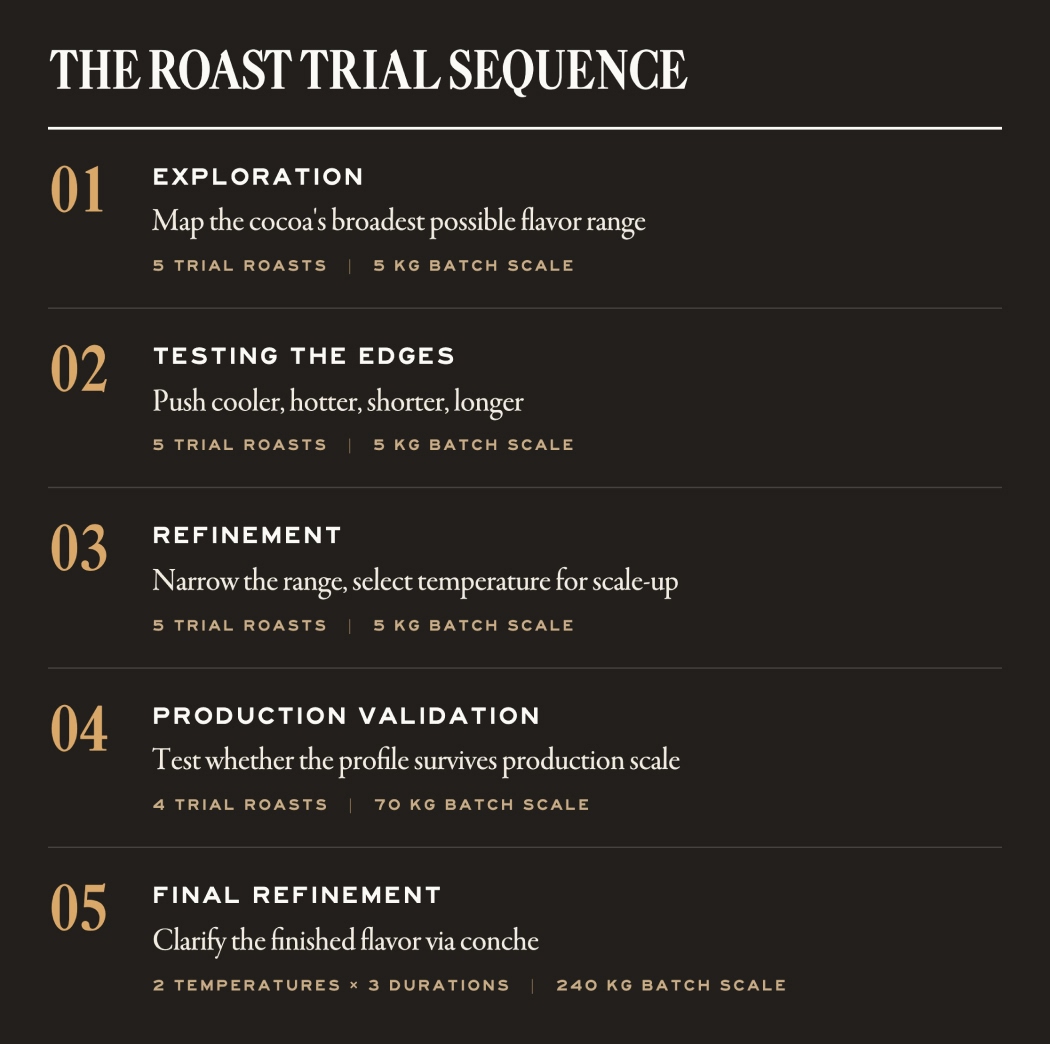
Mapping the Range
Our first three rounds of testing Río Samaria were exploratory in nature. Round 1 cast a wide net across five 5-kilo roasts to map the broadest possible flavor territory:
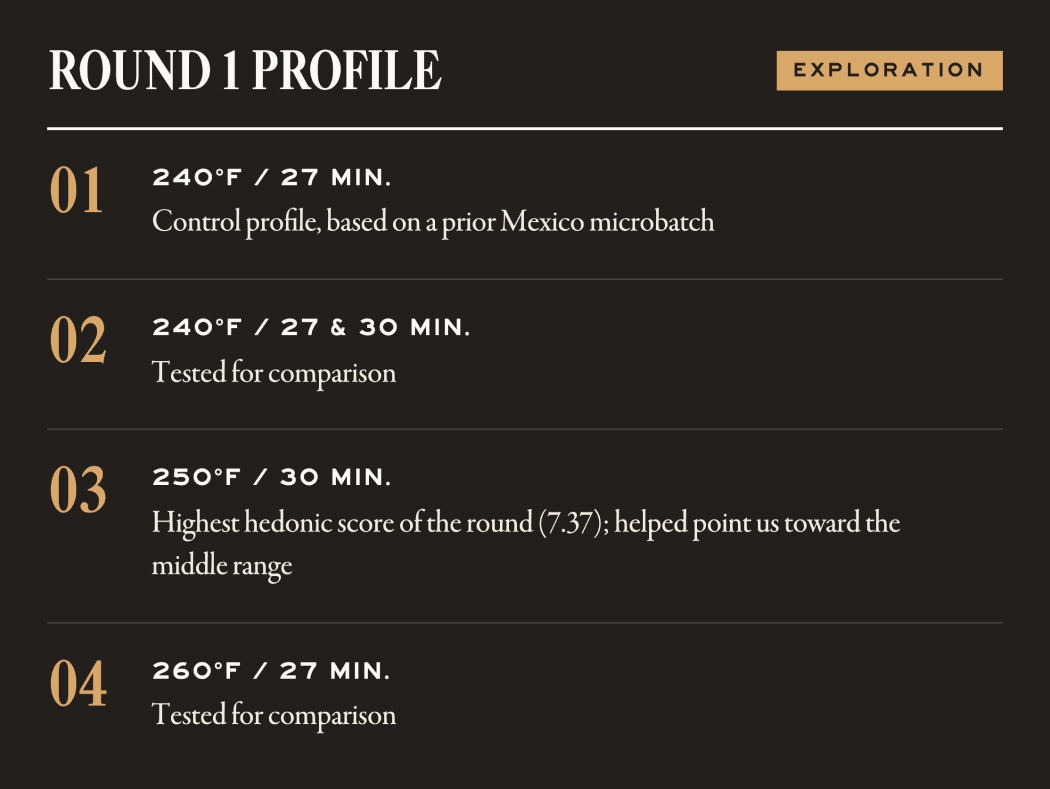
Round 2 pushed the edges (cooler and hotter, shorter and longer) to see where the cocoa broke down:

Round 3 narrowed back in, testing whether the flavors could hold together in balance rather than collapsing into bitterness or diffusing the complexity:

The most memorable feedback from this stretch came early, in Round 1: hoisin sauce. It was unexpected and amusing, and its dark aromatic depth was surprisingly accurate. That descriptor never made it onto our label, but it told our team this cocoa wasn’t going to fit neatly into a category.
Sampling of taster comments:
“Really good balance of spice and fruitiness.”
“Creamy dairy, not overly tangy, with an oak-wood finish.”
“Extremely interesting. Hoisin sauce, slight chocolate.”
Preliminary Learnings
While cooler roast profiles could feel bright but unfinished, hotter profiles tended toward too roast-dominant, burying the fruit and wood that made this cocoa unusual. We found that at the middle ground — near 250°F — fruit, chocolate, balanced sweetness, toasted grain, and wood had the best chance of appearing together. By the end of Round 3, the decision was to move 250°F to the 70-kilo production roaster and to test four durations: 32, 34, 36, and 38 minutes.
Scaling Flavor
We ran four production roasts at one temperature, with a six-minute spread. We expected the results to be subtle. They weren’t. Even two-minute differences created noticeable changes in the finished chocolate:

At 36 minutes, the winning roast didn’t simply taste better than the others — it tasted more connected. The fruit was still the first thing we noticed, but it had moved toward concentrated stone fruit (rather than broad tropical intensity), giving way to earthy chocolate and toasted grain, then a subtle dry, woody, tobacco-like finish.
Bringing the Flavor Into Focus
Roasting establishes the chocolate’s basic architecture. Conching determines how clearly those flavors appear in the finished bar. We ran two full 240-kilo conche batches, at 60°C and 70°C, each evaluated at 24, 30, and 36 hours. Across both temperatures, the 36-hour samples read as more developed and cohesive than the 24- or 30-hour versions, which felt harsher and less finished.
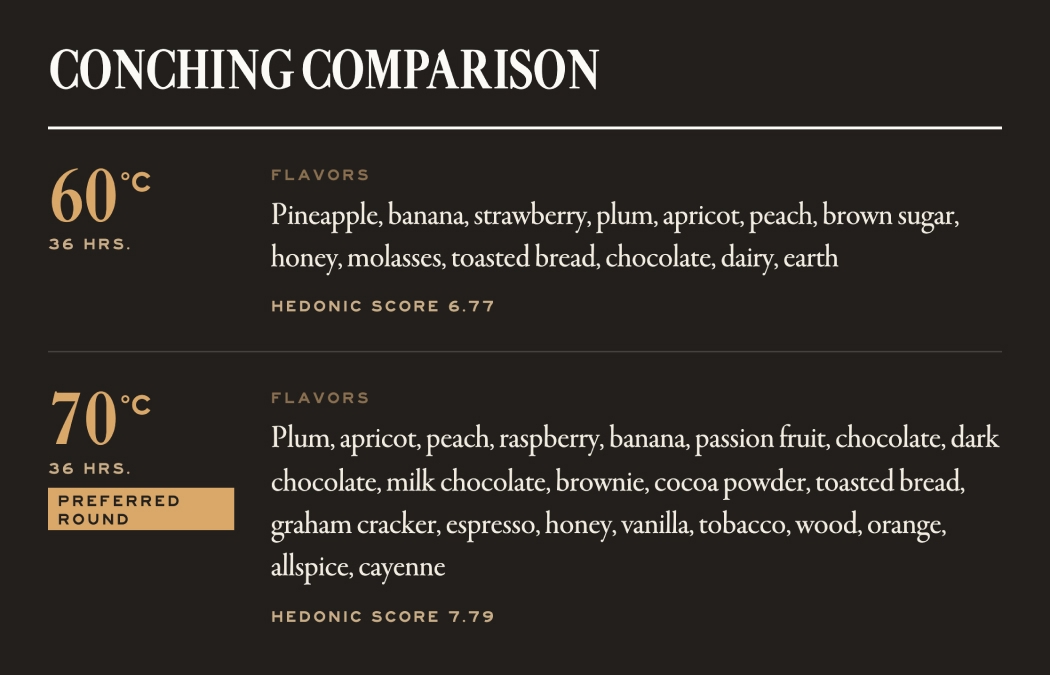
The broader informal tasting group initially leaned toward the bright fruit of the 60°C sample. Nate, our Origin Lead for Río Samaria, and the chocolate-making team preferred the more finished, clearly defined structure of the 70°C sample. For me, the 70°C version tasted more complete: The fruit was still there, but the chocolate’s complexity came into focus. That disagreement wasn’t a failure of the process; it was the process working. The final blind panel later confirmed the 70°C chocolate decisively. We use sensory data to ask better questions, not to replace judgment.
The final conche: 70°C for 36 hours.
Sampling of taster comments:
“Really good balance with all the flavors that the beans provide.”
“Good notes of stone fruit like apricot or peach, keeping the roast notes of sourdough bread.”
“Great chocolatey flavor, smooth, bitter-sour finish, tropical, maybe passion fruit or pineapple.”
The Panel’s Tasting Notebook
Below is the full set of descriptors the panel returned across all rounds, grouped into flavor families. (Of our twenty flavor families, these six kept appearing in our tastings.) Not every panelist found every note — many descriptors surfaced only once, which doesn’t make them meaningless. A one-of-a-kind descriptor can help someone else notice the chocolate differently.

The Finished Chocolate
Plum appeared repeatedly throughout development, often alongside cherry, apricot, peach, raspberry, and strawberry. We chose plum jam because the fruit felt concentrated, sweet, and cooked down — the depth and persistence of fruit transformed by heat; not just fresh acidity. It’s the first note to appear.
After the fruit, the chocolate turns warmer and earthier. Champurrado, the spiced Mexican beverage made with chocolate and masa, captured the flavors of earthy chocolate, toasted grain, and bread. It appears through the middle.
Wood, leather, oak, smoked wood, earth, and tobacco appeared across multiple rounds. We chose tobacco leaf for its dry, earthy, toasted, subtly leafy character — the note that remains after the chocolate has melted away.
The final three notes don’t represent every flavor this chocolate contains — they’re the path we chose through a much larger landscape.

If you give our Río Samaria, Mexico bar a try, let us know what you taste.
0 Comments